An antenna is a listening device. This project came upon following the principle of electroacoustic pianos where the pickup under each tine is a coil and a magnet translating a moving field into a signal.
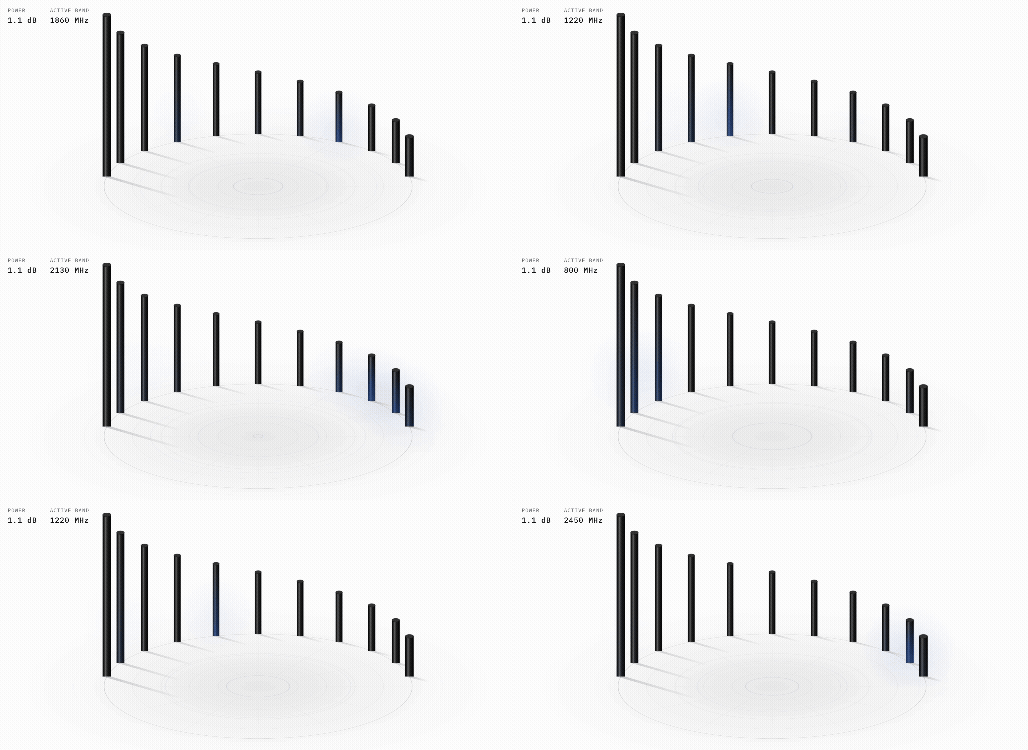
The design that works, and the basis of the current prototype. The AD8317 covers 1 MHz to 10 GHz, which takes in every cellular band plus 2.4 GHz wifi. Four connections: power, ground, antenna in, voltage out. The detector's output has a negative slope. This is roughly −22 mV per dB, so more arriving power means lower voltage, which the...
600 MHz system (AD8307): Teensy 4.1 , AD8307 logarithmic detector, 9V battery. Simpler, cleaner, and wrong. The AD8307 board covers 1–600 MHz. Cellular transmission lives at 700, 850, 900, 1800, 2100 and 2600 MHz, the entire target is above the ceiling. A useful reminder that the constraint that kills a design is often printed on the part in millimetre type....
Teensy 3.1, LM2596 buck converter, LNA, logarithmic detector , 9V mains adapter. The first attempt, and the most over-built. A low-noise amplifier ahead of the detector, and a switching regulator dropping mains-adapter voltage to run it. Both turned out to be liabilities: the LNA saturates the moment a phone gets close, and a switching supply injects exactly the kind of...
A stereo electromagnetic microphone. Two coils at right angles, a preamplifier, a 9 V battery and a headphone jack and deliberately no magnet, which is the one part that separates it from a guitar pickup. It hears the immediate fields of objects: mains transformers at 50 Hz, the whine of switching supplies, the rhythmic texture of a laptop's processor, ticket...